
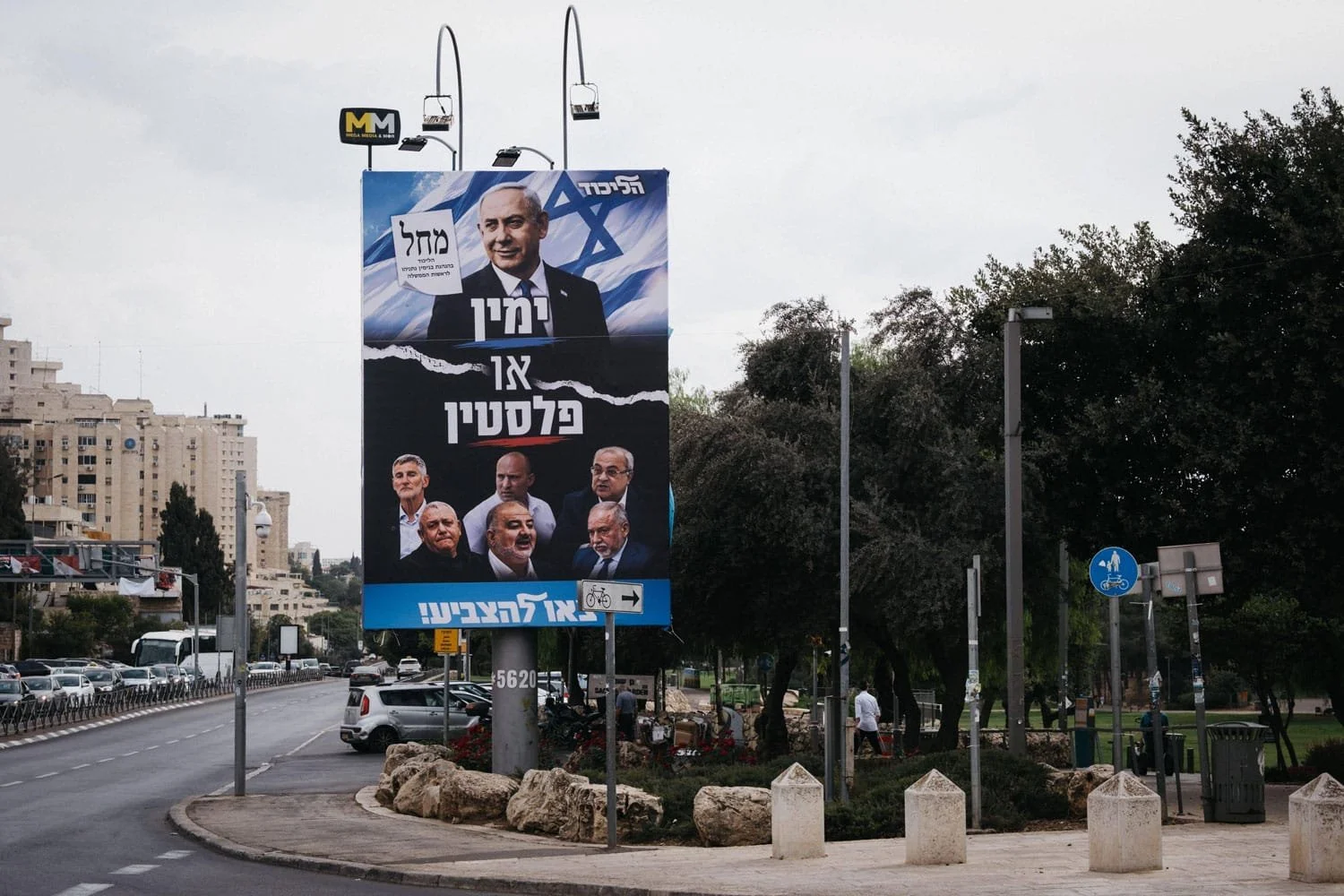
“This election is simply between a Bibi bloc and Anti- Bibi bloc, kind of a referendum on Benjamin Netanyahu,” an Israeli electoral expert told Field.
The final Israeli polls uniformly projected that the pro-Netanyahu bloc will win 50 seats in the next Knesset, the opposition 56 seats. A leading Israeli think tanker told us, “The most probable outcome of these elections is a deadlock. That will lead to a caretaker government headed by Netanyahu until the legal period to form a government is exhausted, which could be up to seven months before new elections are held.”
This is precisely what happened before, between 2019 and 2022, when Israel held five elections as rival blocs repeatedly tried and failed to form a stable government, triggering consecutive rounds of elections. Either bloc could reach 61 seats were it to partner with the Arab bloc.
The “Arab bloc” are the collective seats from Israel’s Palestinian citizens minority voters, who are projected to win 14 seats. The Israeli electoral expert told us, “Both Bibi and Eizenkot’s blocs have been clear that they won’t join a coalition with the Arab parties. The Israeli Central Elections Committee even tried to oust Arab parties from participating in the elections. Both blocs prefer an inconclusive result to one that includes the minority 20% of the population.”
An Israeli analyst told Field that “the polarisation in Israel is so bad that even the ‘moderate’ Israeli politicians cannot partner with the Arabs.” The think tanker told us that “the Arab parties themselves have no choice but to choose between bad and worse. They could be the kingmakers if they are invited to join the opposition bloc or they could offer a conditional safety net to a minority opposition government. Such an arrangement, however, would leave the governing coalition vulnerable to defections and disputes over major policies.”
The Israeli electoral expert told Field that “campaign talk is different to post-election talk, where considerations may change. Other options that remain on the table range from a unity government, a rotating premiership or even an option where a different Knesset member from either camp forms a government. Defeating Netanyahu at the ballot box does not necessarily mean removing him from power.”
Even in the event that an arrangement can be reached, the prospect of a stable government is limited. A Western diplomat based in Jerusalem commented, “The only thing in common between Yair Golan, the leader of the democrats, and Avigdor Liberman, the leader of Yisrael Beiteinu, is that they despise Netanyahu. How can they form a coalition when they differ on their approach to Israel’s democratic nature, judicial reforms, approach to security and relationship with the Palestinians and the region?”
Prospects of a calmer approach to regional peace and security appear unlikely. “Netanyahu needs security threats, war and fear for his political survival,” an Israeli opposition supporter told us. “He failed to re-ignite the Iranian front ahead of the elections, so now he must work with what he has. He is exploiting the attack in Hebron [two Israeli soldiers were killed at a checkpoint in the West Bank on 23 October] to fan the flames in the West Bank and heighten the public's sense of a security emergency. His entire election strategy is based on fearmongering and feeding into the siege mentality of the Israeli public.”
Interestingly, Netanyahu appears to be expecting to remain in power in some capacity and is preparing Israel for the consequences of his continued leadership, as his standing continues to plummet globally. On 23 October, Netanyahu said that Israel must prepare for banking sanctions and a decrease in U.S. aid, proposing cryptocurrency as a potential means of evading the impacts of economic sanctions.
An official in Israel’s banking industry told Field that Netanyahu’s announcement took the sector by surprise. “The global negative sentiment towards Israel has resulted in money flowing out of Israel, but floating the use of digital currency to mitigate sanctions is a step too far. Are we going to join Iran, Russia and North Korea on the list of countries cut off from SWIFT?”
Another Israeli financier told Field, “Netanyahu has shot himself in the foot with this statement. He is basically telling the Israeli public and international investors that sanctions against Israel under his potential renewed term are inevitable, including from the U.S., Israel’s biggest ally. How is this a message of confidence to voters? If anything, it will make them concerned about their savings and encourage Israeli citizens to move their money out of the country.”
The think tanker concluded, “These elections are taking place within a divided Israeli society, regional instability and growing global isolation. They are consequential but are unlikely to provide any immediate meaningful changes to Israel’s domestic challenges and its policies towards the Palestinians and the region.”
